The Slippery-Slip
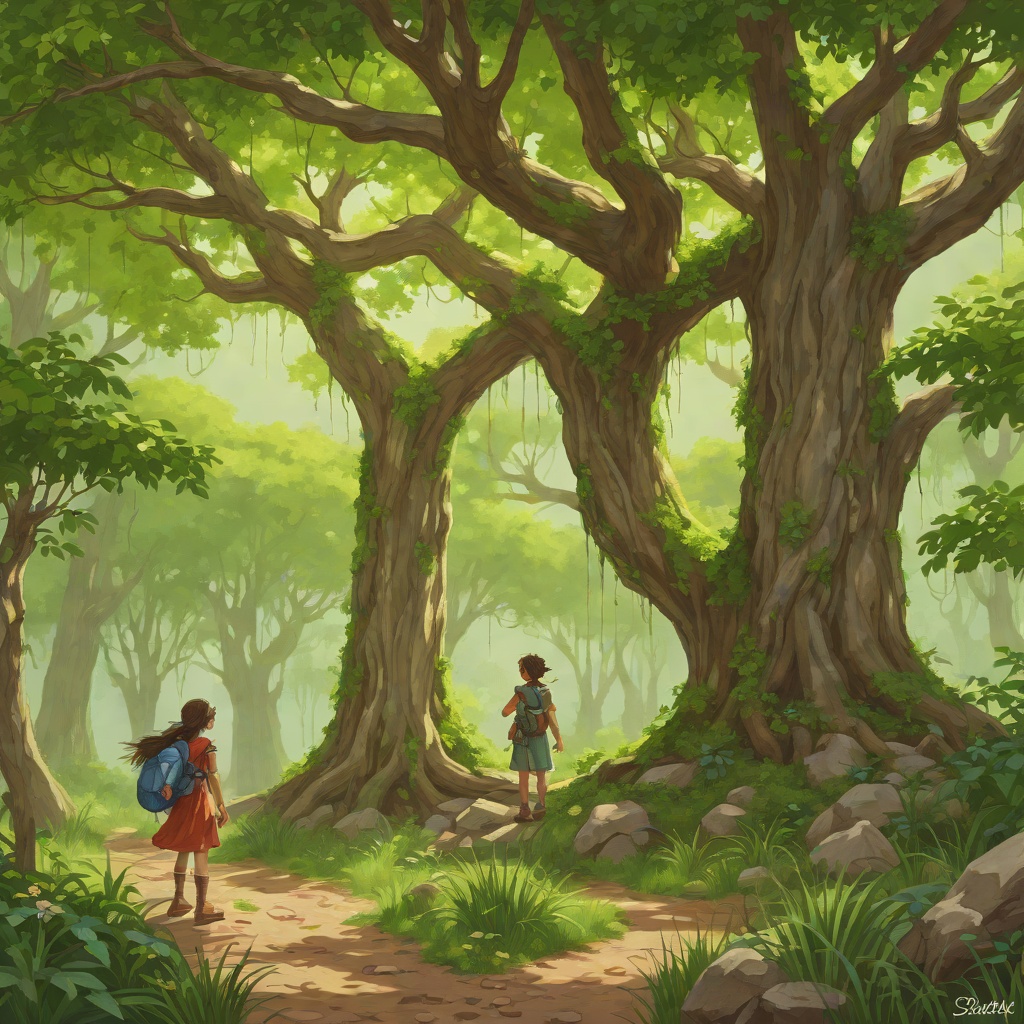
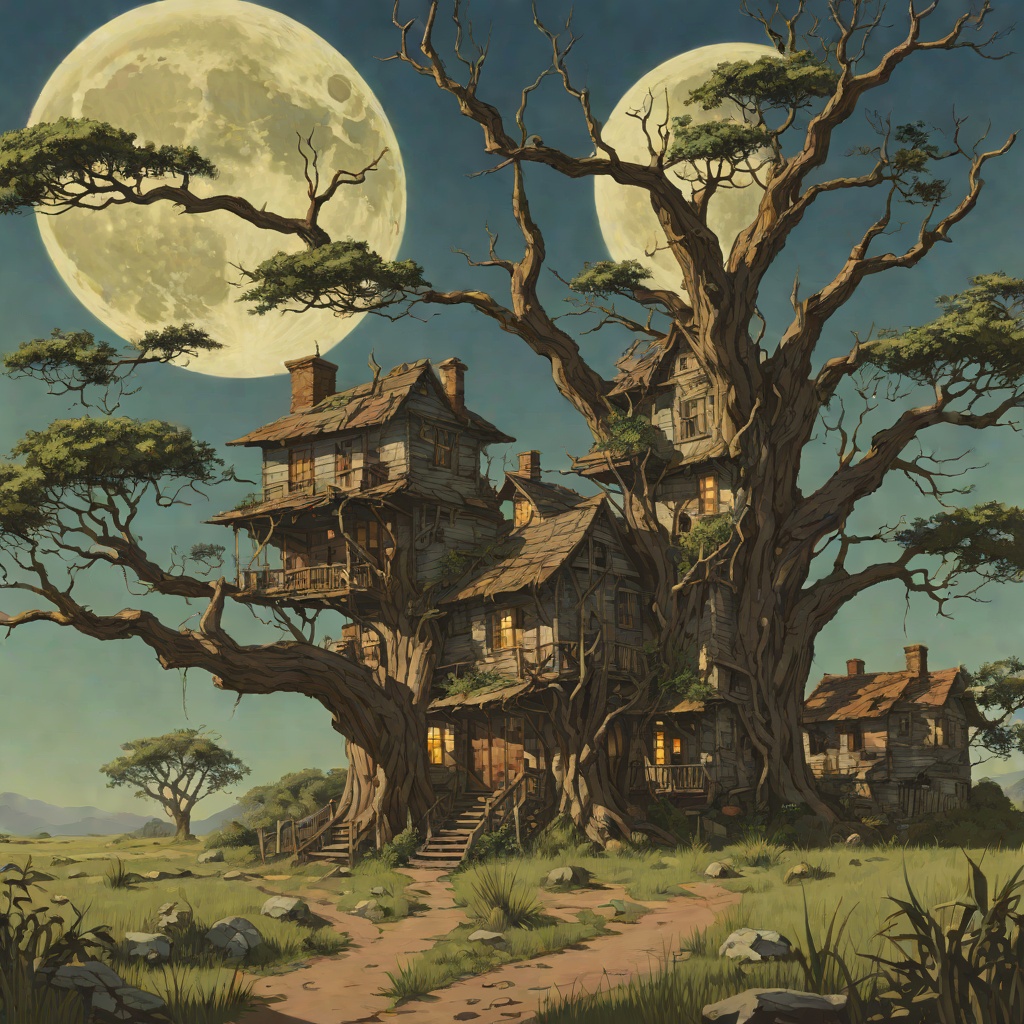
The Faraway TreeThe Slippery-Slip is the Faraway Tree’s internal slide, running from the top of the tree to the bottom and belonging to Moon-Face. More than a curiosity, it is the tree’s principal vertical route: a playful entrance and exit, a means of escape, and a narrow threshold whose condition can determine whether people are free to move or trapped in darkness. Its recurring reversals give the enchanted tree a physical logic of openings, descent, obstruction, and release.
Definition and Structure
The Slippery-Slip begins in the middle of Moon-Face’s round room as a large hole and winds downward inside the trunk in a continuous spiral. Moon-Face’s furniture is curved to fit the tree around it, making the slide part of the room’s architecture rather than an object merely installed within it. The bed, chairs, sofa, and stove follow the curve of the trunk, while the opening in the floor leads directly into the descending passage.
The route extends from the uppermost regions of the Faraway Tree to the ground. After the children and their companions reach the topmost branch, they pass through a purple hole in the cloud and enter another land; when Jo is separated from the others, the Slippery-Slip remains the known route back toward the tree below. The surrounding tree is itself a layered passage, approached through a narrow ditch beside the lane, climbed by branches and ladders, and connected to cloud and other lands. Within that vertical network, the slide provides the most immediate and exhilarating downward movement.
Ordinary Use and Pleasure
Moon-Face lends cushions to people who want to use the slide. Dick receives a red cushion, sits at the top, and is pushed by Bessie. He travels safely around and around the inside of the enormous Faraway Tree before shooting out through the trapdoor at the bottom and landing on soft green moss, breathless from the ride. His question about whether Moon-Face wants the cushions returned shows that the route is organized as a hospitable service: its danger is moderated by equipment, custom, and the owner’s willingness to share it.
The descent is not simply transportation. Its repeated circular motion produces excitement and wonder, making the tree’s interior feel alive with unusual possibilities. At the end of one adventure, the whole group slides down at top speed before walking home and discussing what has happened. Later, the children return from the Land of Presents with gifts balanced on their knees so that they will not break, then take the descent one by one and shoot out through the front door. The same route that carries bodies also carries the material evidence of their adventures back into ordinary domestic life.
A Route Through Danger and Confinement
The Slippery-Slip’s usefulness becomes clearest when escape depends on it. In the Land of Spells, the children and their companions find themselves at the top of an enchanter’s tower after a trick sends them up hundreds of stairs. They are left in a round room with one small window, a bench, and a table, far above the ground; Moon-Face recognizes that returning down the stairs will not help because the door below will be locked. The slide is not present there, but the scene establishes the kind of spatial imprisonment from which a special route such as the Slippery-Slip can provide release.
Moon-Face proposes using a broomstick and applying Whizz-Away Ointment to it, but Jo points out that the room contains only a table and a bench. The eventual escape depends on turning the table into a flying vehicle, while the enchanter’s servants, including a dozen small imps, are sent to capture the fugitives. The contrast makes the Slippery-Slip stand out as the Faraway Tree’s dependable counter-space to the enchanter’s locked tower: one space multiplies stairs and closes exits, while the other makes descent immediate.
Its freedom is not guaranteed, however. When the Old Woman takes Moon-Face’s house, she looks down the opening and mistakes it for a coal-hole. She has a board made and nailed across it, then places Moon-Face’s bed over the obstruction. The result is not merely an alteration to the room’s furnishings. By sealing the hole, she removes Moon-Face’s access to the route that defines his home and turns a familiar passage into a blocked absence. When Moon-Face peers through the window and sees what has happened, he is left asking what he can do with his slide closed.
The route is later threatened in a more violent way. Sir Stamp-a-Lot and Lady Yell-Around, fugitives from the Land of Tempers, force Silky, Moon-Face, and the Saucepan Man into the passage and stop both ends. They push the companions down the Slippery-Slip and stuff the opening in Moon-Face’s room with cushions, boughs, carpets, leaves, and other materials. The prisoners cannot get up or down. A route designed for effortless motion becomes a packed vertical chamber, and the very objects intended to make descent safe become part of the confinement.
Rescue, Repair, and Collective Action
The blocked slide creates a rescue problem that cannot be solved by simply entering at either end. The children first suppose that the Slippery-Slip might provide their own way down, but the obstruction at the bottom makes that impossible. Watzisname identifies the likely cause: the two people from the Land of Tempers have pushed the friends inside and filled the passage to imprison them. The discovery changes the slide from a convenient shortcut into the central site of the rescue operation.
Jo finds a solution by treating the tree as material wood rather than as an untouchable magical environment. He explains that a woodpecker can make a nest by pecking a hole with its strong beak and suggests cutting through the back of the room into the Slippery-Slip. The plan brings nonhuman labor into the rescue: the woodpeckers’ drumming beaks enlarge a hole until it is large enough for someone to pass through. Jo shines his torch into the slide, sees a light farther down, and notices a shaking rope, evidence that someone inside is holding on and that the trapped companions are still present.
The rescue also uses sound as a form of communication. The Saucepan Man’s familiar nonsense song announces that the prisoners are there, allowing Jo to locate and address them through the newly opened breach. Once the spell imposed by the two intruders has gone with their departure, Moon-Face says that everything can be pulled out. The passage is therefore restored not by one heroic action but by cooperation among the children, the woodpeckers, and the prisoners themselves, each contributing a different form of knowledge or effort.
Narrative Function and Significance
The Slippery-Slip repeatedly converts impossible vertical distance into a manageable action. It lets a child descend through the Faraway Tree, allows a group to return from extraordinary places, and makes Moon-Face’s round room feel connected to the forest floor rather than isolated above it. Yet the same passage can be blocked by a board, a bed, or loose materials; its narrative force comes from the sharp difference between fluid movement and total immobility.
Its circular descent also gives the adventures a recurring rhythm. Characters leave the familiar ground by crossing the wood, climbing the tree, and passing through the cloud above; they return by reversing that upward movement through a spiraling interior route. The Slippery-Slip is thus a threshold between domestic safety and enchanted danger, but it is also a mechanism of reintegration. After the excitement of the upper lands, the children land at the tree’s entrance, carry their presents home, and resume the ordinary world.
The object’s ownership and shared use express the social character of Moon-Face’s home. He lends cushions and permits visitors to use the slide, so hospitality is built into the architecture. When the Old Woman blocks it, she attacks not only a hole in the floor but the communal openness of the room. When the children and the woodpeckers reopen it, they restore both physical circulation and the relationships dependent on that circulation. The Slippery-Slip finally represents a form of freedom that exists only while passages remain open: movement, friendship, rescue, and return all become possible through the same extraordinary route.